

Abstract
The era of foundation models has revolutionized AI research, yet Graph Foundation Models (GFMs) remain constrained by the scarcity of large-scale graph corpora. We introduce GraphMaster — the first multi-agent framework specifically designed for graph data synthesis in data-limited environments. GraphMaster orchestrates four specialized LLM agents (Manager, Perception, Enhancement, and Evaluation) that collaboratively optimize the synthesis process through iterative refinement, ensuring both semantic coherence and structural integrity.
Motivation
Graph Foundation Models face a critical data bottleneck. Existing synthesis methods fail for three reasons: (1) classical augmentation (GraphSmote, G-Mixup) only manipulates structure, producing semantically empty nodes; (2) LLMs cannot process entire graphs within context windows; (3) uncoordinated LLM generation introduces hallucinations that violate graph topology.
Method
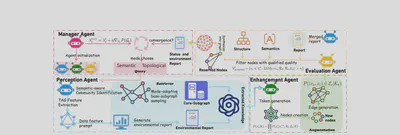
GraphMaster decomposes graph synthesis into four specialized agents:
- Manager Agent — Selects between semantic and topological enhancement modes based on environmental analysis, and coordinates the entire synthesis workflow.
- Perception Agent — Overcomes context-window limitations via semantic-aware community detection, mode-adaptive seed selection, and hierarchical PPR-based diffusion sampling to extract representative subgraphs.
- Enhancement Agent — Generates new nodes and edges conditioned on extracted knowledge, with dual-mode generation for semantic coherence and structural fidelity.
- Evaluation Agent — Assesses quality through multi-dimensional scoring (semantic + structural), with adaptive threshold and temporal convergence detection for iterative refinement.
Experimental Results
Evaluated on 6 data-limited benchmarks with 4 GNN architectures (GCN, JKNET, GraphSage, GAT) on 8x A100 GPUs using QwQ-32B as the base LLM.
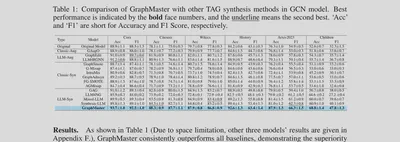
GraphMaster consistently outperforms all baselines across all datasets. The bottom row (blue) shows GraphMaster achieving the highest accuracy and F1 scores on every benchmark.
Graph Feature Preservation
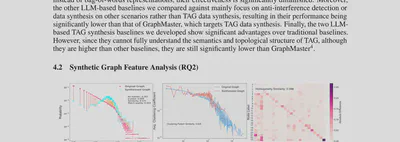
The synthesized graphs maintain high fidelity: KS statistic 0.357 (p=0.059) for degree distribution, 0.835 clustering coefficient similarity, and 0.988 label homogeneity — indicating near-perfect structural preservation.
Ablation Study
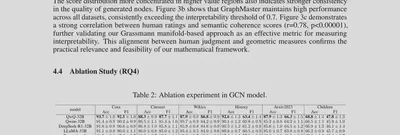
Removing the Evaluation Agent causes the largest performance drop, confirming the critical role of iterative quality control. Each agent contributes uniquely to the final synthesis quality.