

Abstract
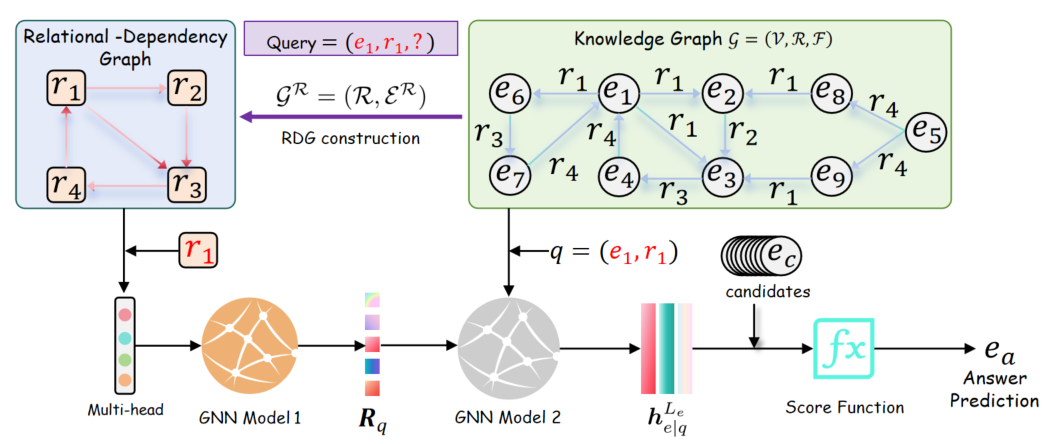
Knowledge-graph reasoners often struggle when test-time entities and relations were never observed during training. GraphOracle addresses this fully-inductive setting by converting each knowledge graph into a directed Relation-Dependency Graph (RDG). The RDG captures how relations compose, and its query-aware embeddings guide answer prediction on the original entity graph.
Motivation
Relation order matters: “born in → located in” carries a compositional direction that an undirected relation graph erases.
Existing fully-inductive methods construct dense, undirected relation graphs. This makes computation expensive and loses directional dependencies that are essential for multi-hop reasoning. The same limitation makes it difficult to transfer a learned reasoner across domains with different entity and relation vocabularies.
Method
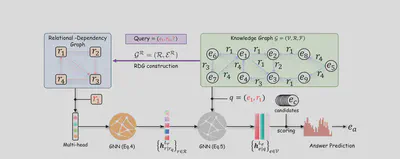
GraphOracle operates in three stages:
- RDG Construction — Transform the KG into a directed Relation-Dependency Graph where edge (r_i, r_j) indicates that relation r_i precedes r_j in observed triple chains. This is significantly sparser than prior relation graphs while capturing compositional patterns.
- Query-Dependent Multi-Head Attention — For each query relation, a multi-head attention GNN propagates messages over the RDG to produce context-aware relation embeddings. The same relation gets different representations depending on the query context.
- Entity-Level Answer Prediction — The learned relation embeddings parameterize a second GNN on the original KG entity graph, performing inductive message passing from the query entity to score candidates.
Experimental Results
Evaluated across 60 benchmarks spanning transductive, entity-inductive, fully-inductive, and cross-domain settings.
MRR Comparison on 60 Datasets
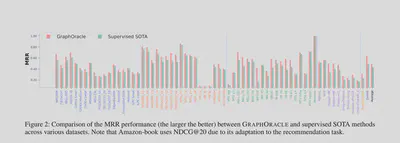
GraphOracle (red) consistently matches or outperforms supervised SOTA (green) across all 60 datasets, with particularly strong gains on cross-domain and biomedical KGs.
Average Performance (4 Settings)
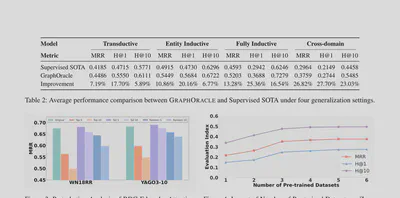
GraphOracle achieves +7.19% MRR improvement in transductive, +10.86% in entity-inductive, +13.28% in fully-inductive, and +26.82% in cross-domain settings over supervised SOTA.
Ablation Study
Removing the RDG structure or multi-head attention causes significant performance drops, confirming both components are essential. The directed precedence encoding is the single most important design choice.
Presentation
Citation
@inproceedings{du2026graphoracle,
  title     = {GraphOracle: Efficient Fully-Inductive Knowledge Graph
               Reasoning via Relation-Dependency Graphs},
  author    = {Du, Enjun and Liu, Siyi and Zhang, Yongqi},
  booktitle = {Proceedings of the AAAI Conference on Artificial
               Intelligence (AAAI)},
  year      = {2026},
  note      = {Oral Presentation}
}