LEDGERMIND
Provenance-Constrained Multimodal Agentic Reasoning with a Structured Evidence Ledger


Why trajectory faithfulness matters
A multimodal agent does more than emit an answer. It observes images, calls tools, retrieves evidence, forms intermediate claims, and sometimes repairs its own trajectory. Final-answer accuracy compresses all of this into one bit: correct or incorrect. It cannot reveal whether the answer was grounded, guessed from a language prior, or reached through errors that happened to cancel out.
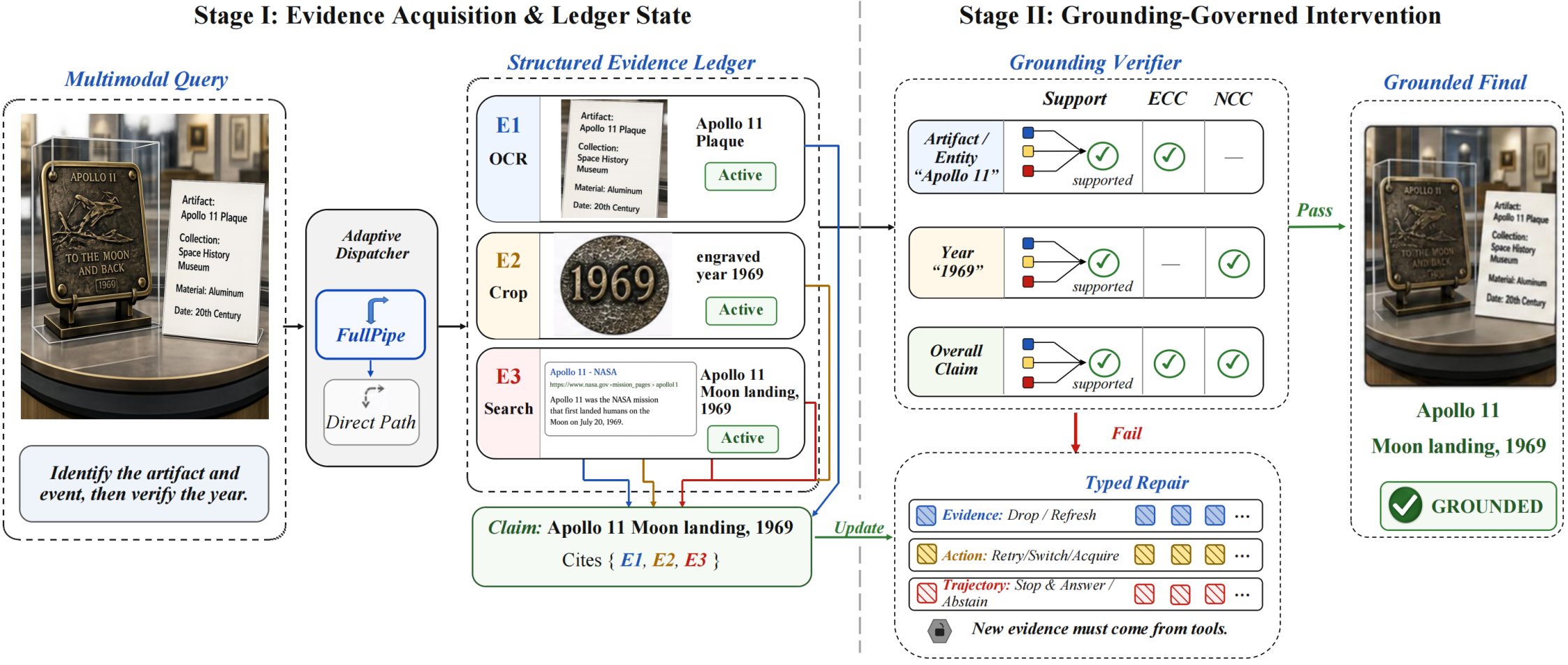
LedgerMind treats the agent trajectory as an auditable state machine, not a free-form scratchpad.
This perspective targets four recurring failure modes: unsupported intermediate claims, citation-backed entity hallucination (Phantom Grounding), unnecessary deep reasoning on simple queries, and new unsupported content introduced during repair.
The LedgerMind runtime
LedgerMind places a Structured Evidence Ledger at the center of the agent. Each perception or retrieval result is normalized into a typed entry with its source, confidence, lifecycle state, and dependencies. Downstream claims may cite only active entries, turning provenance from a prompting preference into an execution constraint.
The runtime proceeds in two stages:
- Evidence acquisition and ledger state. An adaptive dispatcher chooses either a direct path or the full tool pipeline. Tool outputs are recorded as active ledger entries rather than mixed into an unstructured text history.
- Grounding-governed intervention. Every decision claim passes support coverage, Entity Consistency Check (ECC), and Numeric Coherence Check (NCC). A passing claim becomes the grounded final answer; a failing claim can trigger only predefined evidence-, action-, or trajectory-level repair.
Three-layer grounding
- Support coverage checks whether the claim is substantively covered by its cited evidence.
- ECC requires conclusion-level entities to appear in the cited evidence, with alias handling.
- NCC requires numerical values to match cited values under type-aware tolerances.
Together, these checks catch claims that cite valid evidence IDs while quietly introducing a different entity, year, count, or measurement.
Adaptive execution and constrained repair
The Adaptive Dual-Path Dispatcher avoids routing every query through an expensive reasoning pipeline. Simple or knowledge-oriented queries can take the direct path, while questions requiring perception, retrieval, and multi-step reasoning use the full pipeline.
When verification fails, the Event-Triggered Verification-and-Repair engine applies typed state transitions. It may drop or refresh evidence, retry or switch an action, or stop and answer—but new evidence must still come from tools. This gives repair a provenance non-amplification guarantee.
Results
LedgerMind is evaluated on six public benchmarks—VTC-Bench, MMStar, MMMU, MMMU-Pro, EMMA, and MC-Search—plus the Hard-200 stress set, using six frontier MLLMs from four vendors.
- On VTC-Bench, LedgerMind with Gemini-3-Flash reaches 58.9%, while the same runtime improves GPT-4o by 23.3 points.
- On EMMA, it reaches 58.29% overall, a 9.58-point gain over the strongest thinking-mode baseline.
- On Hard-200, every tested backbone improves by 11.2 to 19.7 points overall, with no negative sub-source result.
- Trajectory-level audits show gains beyond answer accuracy, especially against unsupported reasoning and Phantom Grounding.
The ablations reinforce the design: removing the ledger causes the largest degradation, free-form repair is substantially weaker than typed repair, and disabling ECC/NCC most strongly harms the difficult split.
Citation
@article{du2026ledgermind,
  title   = {LEDGERMIND: Provenance-Constrained Multimodal Agentic
             Reasoning with a Structured Evidence Ledger},
  author  = {Du, Enjun and Zhou, Hange and Du, Chenxu and Liu, Siyi
             and Chen, Zirong and Zheng, Ziyu and Zhang, Yongqi},
  year    = {2026}
}