

Abstract
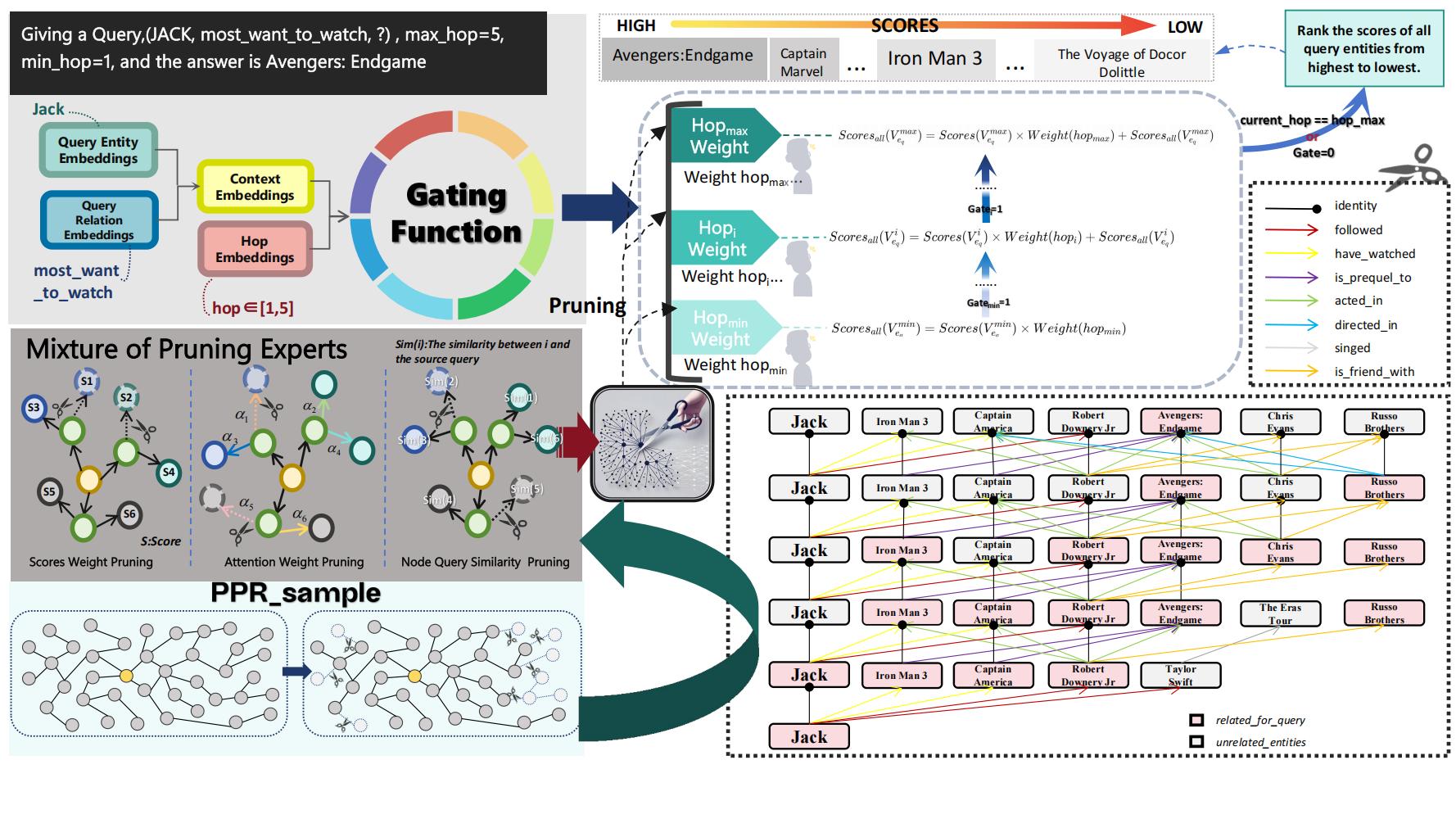
Knowledge-graph reasoning depends on finding the right paths—not simply exploring more of them. MoKGR personalizes graph traversal with two mixture-of-experts modules: one chooses an appropriate reasoning depth for each query, while the other decides which candidate paths deserve to survive.
Motivation
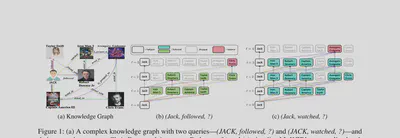
Different questions over the same graph may need completely different search budgets.
The query (JACK, followed, ?) may resolve within three hops, while (JACK, watched, ?) can require deeper exploration. Fixed-depth GNNs spend too much work on simple questions and stop too early on difficult ones. Uniform pruning compounds the problem by applying one notion of relevance to every relation and query.
Method
MoKGR introduces two complementary Mixture-of-Experts modules:
- Mixture of Length Experts — Experts specialize at different reasoning depths. A learned gate assigns query-specific weights, routing simple queries toward short paths and complex queries toward deeper ones.
- Mixture of Pruning Experts — At each layer, multiple experts judge candidate paths from complementary perspectives before a learned aggregation keeps the most informative ones.
- End-to-End Training — Both modules are trained jointly with the answer prediction objective, ensuring optimal synergy between depth selection and path pruning.
Experimental Results
Transductive Setting (6 Benchmarks)
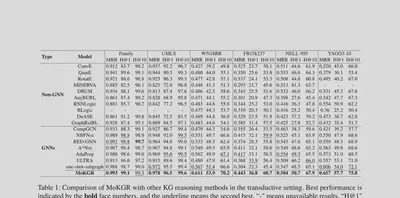
MoKGR achieves the best results across all 6 benchmarks (Family, UMLS, WN18RR, FB15k237, NELL-995, YAGO3-10), outperforming both non-GNN baselines and state-of-the-art GNN methods including NBFNet, RED-GNN, A*Net, and AdaProp.
Efficiency & Convergence
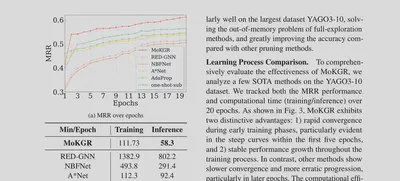
MoKGR converges significantly faster than competing methods while maintaining lower inference time, demonstrating that personalized path exploration is both more accurate and more efficient.
Expert Selection Analysis
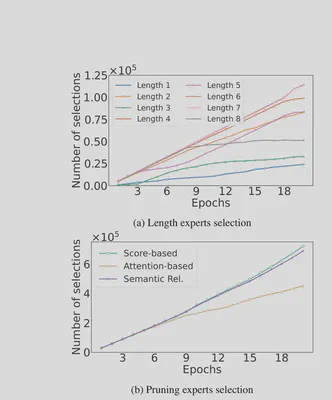
The learned gating weights show interpretable patterns: the model prefers medium-length paths overall, but adapts dynamically — shorter paths for simple relational queries, deeper paths for complex multi-hop reasoning.
Ablation Study
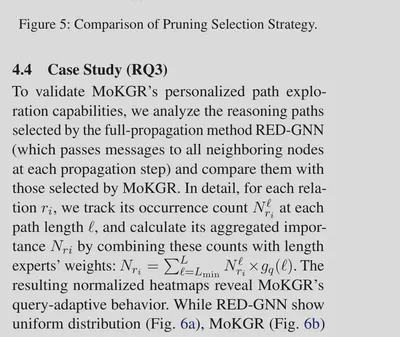
Removing the length experts causes the largest drop, confirming that adaptive depth is the most critical innovation. Removing pruning experts or using a single expert also degrades performance.
Presentation
Citation
@inproceedings{du2025mokgr,
  title     = {Mixture of Length and Pruning Experts for Knowledge
               Graphs Reasoning},
  author    = {Du, Enjun and Liu, Siyi and Zhang, Yongqi},
  booktitle = {Proceedings of the 2025 Conference on Empirical Methods
               in Natural Language Processing (EMNLP)},
  year      = {2025},
  note      = {Oral Presentation}
}