Motivation
Why do conventional AV benchmarks overestimate auditory ability?
Visual objects and typical sounds are highly correlated in natural videos. When shown a piano, car, or dog, a model can ignore the audio track and still generate “piano music,” “engine noise,” or “barking” from visual priors. The answer looks plausible, but it does not prove that the model listened.
The shortcut
The image is enough to guess a usually correct sound
On a congruent audiovisual clip, a visual guess and genuine auditory recognition produce the same answer, so conventional accuracy cannot distinguish them.
VisibleModel answer
piano → “I hear piano music.” ✓
The diagnostic counterfactual
Keep the image plausible while changing the audio facts
If the same piano video actually contains birdsong, answering “piano” reveals visual override. If piano and bird coexist but the model reports only piano, it reveals auditory omission.
Actually audibleModel answer
bird → “I hear piano.” ✕
≠
Being correct on CLEAN does not imply that the model used audio.Genuine auditory ability must persist when visual priors fail, sounds compete, or the evidence weakens.
Core insight
Locked video, change only the audio facts.
OST-DiagBench turns every source clip into a paired experiment. Video content and visual cues are locked; only the presence of the complete CLEAN track and the addition of a donor sound are controlled. Changes in model output can therefore be attributed to changes in auditory evidence.
Construct four acoustic realities for the same video and observe when the model listens, misses a sound, or substitutes vision for hearing.
01Lock the video to eliminate visual-content differences
02Control the source / donor composition
03Compare responses within the same source group
Donor absent
Donor present
Source-containing CLEAN track kept
S=1 · D=0CLEAN
Vision and audio agree: can the model report the original source?
S=1 · D=1MIX
Source and donor coexist: can the model capture both?
Source-containing CLEAN track removed
S=0 · D=0MUTE
The sound is absent: does the image still induce the model to report the source?
S=0 · D=1SWAP
The donor replaces the original track: does the model trust hearing or vision?
CLEAN · agreementBasic recognition ability, but not sufficient on its own to prove audio use.
MUTE · absenceMeasures visually induced false sound reports.
SWAP · contradictionMeasures whether a counter-visual donor overrides the visual script.
MIX · coexistenceMeasures donor omission and joint recall under concurrent sources.
≠
CLASH · subtitle–speech fact conflict A visible subtitle retains the old fact while aligned speech states a locally plausible, mutually exclusive new fact. The correct answer is the spoken value; an identical-waveform A-ONLY route controls audibility.
Benchmark construction
From real videos to interpretable intervention groups
Construction follows one rule: within a group, change only preregistered variables. MIX retains the complete CLEAN waveform and overlays the donor; it requires no source separation and makes no claim of having an isolated source stem.
1
Admit sourceSelect source clips with visible events and reliable acoustic labels.
2
Assign donorAssign near / far events in a balanced way from a non-overlapping donor bank.
3
Synthesize groupGenerate CLEAN, MUTE, matched SWAP, and matched MIX.
4
Common masterApply the same attenuation to the entire group to avoid condition-specific distortion.
5
Verify togetherUse multilabel validation; reject the entire group if any member fails.
≈
Matched SWAP / MIX
Share donor identity, a natural 2–4 s segment, onset/offset, 50–100 ms fades, gain, codec, and mastering. Donor-parameter differences are excluded from the comparison.
dB
Perceptual loudness control
MIX uses overlap-window DLR: δ = Ldonor − Lsource. SWAP has no source, so it uses donor-to-background SNR.
−10 dB
masked
0 dB
balanced
+10 dB
salient
A
Matched A-ONLY calibration
CLEAN/SWAP/MIX-AONLY retain final audio that is byte-identical to the corresponding AV condition. A donor recognized in A-ONLY but missed in AV is direct diagnostic evidence of cross-modal suppression.
↔
Temporal position
Core fixes the onset at the middle. A separate panel uses the same donor segment and gain while varying only early / middle / late position to analyze position, recency, and retention.
Δ
Semantic granularity
FAR-SWAP crosses broad acoustic classes; NEAR-SWAP changes the fine-grained label within the same superclass. This distinguishes “not heard,” “heard only at a coarse level,” and “heard but overridden by vision.”
✓
Artifact-aware acceptance
Check the locked-video signature, source/donor recognizability, DLR/SNR within ±1 dB, true peak ≤ −1 dBTP, A-ONLY hashes, and editing artifacts.
Evidence strengthDLR / SNR curves
Temporal positionearly · middle · late
Semantic proximityNEAR · FAR
CLASH follows a separate fact-level path. It starts from a real source-aligned utterance, leaves the old fact visible, replaces the spoken value with a mutually exclusive alternative, and retains an item only after ASR integrity checks and manual review of the question, edit, visible text, and conflict difficulty.
Operation atlas
Which operations did we generate, and how much data does each contain?
The table reports only the final Challenge benchmark. Constructed counts records generated from 1,068 frozen source clips or balanced subsets; Accepted counts records that passed audio, video, and group-consistency validation and entered the report. Native and neutral-video A-ONLY are separate input routes and are counted separately, but they share the final audio of the corresponding AV condition.
| Suite / operation | What changes | Constructed records | Accepted records |
|---|
| Factorial Core · locked video |
| CLEAN | Retain the complete source-containing CLEAN track | 1,068 | 510 |
| MUTE | Remove the complete CLEAN track and replace it with matched low-level background | 1,068 | 510 |
| SWAP | Background + donor, creating a replacement contradiction | 1,068 | 510 |
| MIX | Complete CLEAN track + donor, creating auditory coexistence | 1,068 | 510 |
| Calibration Controls · native audio-only + neutral-video surrogate |
| CLEAN-AONLY | Identical CLEAN audio through two non-semantic video routes | 2,136 | 1,020 |
| SWAP-AONLY | Identical SWAP audio through two non-semantic video routes | 2,136 | 1,020 |
| MIX-AONLY | Identical MIX audio through two non-semantic video routes | 2,136 | 1,020 |
| Evidence Strength · independently balanced panel |
| MIX DLR −10 / 0 / +10 | Change only the donor-to-source loudness ratio | 288 | 157 |
| Matched SWAP gain/SNR | Match MIX donor gain; report donor/background SNR | 288 | 157 |
| Temporal Position · independently balanced panel |
| MIX early / middle / late | Use the same donor and gain; change only the onset | 288 | 158 |
| SWAP early / middle / late | Match the temporal position used in MIX | 288 | 158 |
| Semantic Granularity · fine-label auditable subset |
| FAR-SWAP + AONLY | Donor from a different broad acoustic class; pair AV with native A-ONLY | 96 | 86 |
| NEAR-SWAP + AONLY | Same superclass but a different fine-grained category; pair AV with native A-ONLY | 96 | 92 |
| All released event-level Challenge records | 12,024 | 5,908 |
| Fact-level CLASH · separate source-utterance path |
| CLASH A+V + A-ONLY | Keep the old visible fact; replace aligned speech with a mutually exclusive new fact | — | 510 items |
A record is not a unique clip. One source generates multiple paired conditions, A-ONLY routes, and panel variants.
Group-level acceptance. If any Core member fails, the CLEAN/MUTE/SWAP/MIX group for that source is removed in full, preventing condition-specific attrition.
Two reporting scopes. Seven event metrics use the same 510 Core groups; CLASH-Acc uses a separate 510-item manually reviewed fact set.
Playable matched example
One guitar video, four audio realities
All four players come from the same accepted source group, ave-0a7683f182e2. Expected facts come from the manifest; model text is the actual output of Qwen2.5-Omni-7B offline.
CLEAN1,068 → 510
Expected auditory factsmusical instrument / guitar
Actual model answer“The audio contains the sound of a guitar being played, with a focus on the plucking of the strings.”
✓ source detectedave-0a7683f182e2__FC__CLEAN__AVMUTE1,068 → 510
Expected auditory factsno salient source or donor; matched background only
Actual model answer“The sound of a guitar being played is heard.”
✕ visual hallucinationave-0a7683f182e2__FC__MUTE__AVSWAP1,068 → 510
Expected auditory factsdog barking; visual musical source is absent
Actual model answer“The audio contains the sound of a dog barking in the background.”
✓ donor detectedave-0a7683f182e2__FC__SWAP__AVMIX1,068 → 510
Expected auditory factsmusical instrument / guitar + dog barking
Actual model answer“The audio contains a guitar being played, with a focus on the strings being plucked.”
! donor omittedave-0a7683f182e2__FC__MIX__AV
!This matched group demonstrates the central value of the benchmark.CLEAN appears to show that the model can listen, but MUTE reveals visual auditory hallucination and MIX reveals omission of the concurrent dog. CLEAN accuracy alone cannot expose either failure.
A-ONLY calibration
The donor becomes audible again when semantic video is removed
The players use a uniform neutral-video carrier; their audio is byte-identical to the corresponding AV condition. Below are real outputs from the same model on the neutral-video route.
CLEAN-AONLY2,136 → 1,020
Expectedmusical instrument / guitar
Neutral-route answer“A lively instrumental piece ... featuring a guitar and a bass guitar.”
✓ source detectedave-0a7683f182e2__FC__CLEAN__AONLY_NEUTRALSWAP-AONLY2,136 → 1,020
Expecteddog barking
Neutral-route answer“The audio contains a dog barking and a sound effect.”
✓ donor detectedave-0a7683f182e2__FC__SWAP__AONLY_NEUTRALMIX-AONLY2,136 → 1,020
Expectedmusical instrument / guitar + dog barking
Neutral-route answer“A lively music track with a guitar and a dog barking in the background.”
✓ both detectedave-0a7683f182e2__FC__MIX__AONLY_NEUTRAL
Matched contrast: The same MIX audio yields only “guitar” with the original guitar video, but “guitar + dog” with neutral video. This is exactly the phenomenon that the Cross-Modal Suppression Gap is designed to quantify; aggregate metrics still report native and neutral routes separately.
Evidence-strength panel
Change only donor loudness: flute music + frog
The three MIX videos use the same source, donor, segment, middle onset, and mastering; only overlap-window DLR changes. Real responses progress from hearing only the flute, to hearing both, to the donor overwhelming the source.
MIX · −10 dB96 → 23 valid
Expectedflute music + frog (donor masked)
Qwen2.5 offline“There is a sound of a flute being played.”
! frog omittedmusic-avqa-r-3daaf1254d42__DLRM10__MIX__AVMIX · 0 dB96 → 51 valid
Expectedflute music + frog (balanced)
Qwen2.5 offline“There is a sound of a frog croaking and a woman playing a flute.”
✓ both detectedmusic-avqa-r-3daaf1254d42__DLRP0__MIX__AVMIX · +10 dB96 → 83 valid
Expectedflute music + frog (donor salient)
Qwen2.5 offline“The audio contains a sound of a frog croaking.”
! flute omittedmusic-avqa-r-3daaf1254d42__DLRP10__MIX__AVMatched SWAP288 → 157 valid
Expectedfrog only; visible flute source is absent
Qwen2.5 offline“The audio contains the sound of a frog croaking and a stream flowing.”
✓ donor detectedmusic-avqa-r-3daaf1254d42__DLRP0__SWAP__AV
Temporal-position panel
Change only when the dog appears: early / middle / late
All three videos use the same guitar + dog pair and 0 dB DLR. Real Qwen3 offline outputs show that early and middle donors are omitted, while the late donor is retained in the final answer.
MIX · EARLY96 → 54 valid
ExpectedDOG EARLY · guitar + dog
Qwen3 offline excerpt“The audio clip features a solo acoustic guitar performance ...”
! dog omittedave-0a7683f182e2__TPEARLY__MIX__AVMIX · MIDDLE96 → 50 valid
ExpectedDOG MIDDLE · guitar + dog
Qwen3 offline excerpt“The audio clip features a solo acoustic guitar performance ...”
! dog omittedave-0a7683f182e2__TPMIDDLE__MIX__AVMIX · LATE96 → 54 valid
ExpectedDOG LATE · guitar + dog
Qwen3 offline excerpt“... guitar ... accompanied by the distinct sound of a dog barking in the background.”
✓ both detectedave-0a7683f182e2__TPLATE__MIX__AVSWAP · MIDDLE96 → 50 valid
ExpectedDOG MIDDLE · dog only; guitar absent
Qwen2.5 offline“The audio contains the sound of a dog barking in the background.”
✓ donor detectedave-0a7683f182e2__TPMIDDLE__SWAP__AV
Semantic-granularity panel
FAR and NEAR donors with the same visible vehicle-horn source
The original vehicle-horn track is removed from both SWAP videos below. A-ONLY recognizes the donor, but when paired with the original video, Qwen2.5 instead reports a visually compatible train horn in both cases.
FAR-SWAPAV 48 → 43 valid
Expectedclock alarm only; visible vehicle horn is absent
AV answer“The audio contains the sound of a train horn blowing.”
Matched A-ONLY answer“... a device beeping ...”
✕ semantic overrideave-5380b0f69bf4__SEMFAR__SWAP__AVNEAR-SWAPAV 48 → 46 valid
Expectedairplane only; visible vehicle horn is absent
AV answer“... a train horn blowing and ... a train moving.”
Matched A-ONLY answer“... a jet engine ... a propeller plane ...”
✕ semantic overrideave-5380b0f69bf4__SEMNEAR__SWAP__AV
Dataset at a glance
Dataset scale, composition, and valid samples
OST-DiagBench contains two frozen stress regimes. The event-level branch admits 1,068 source clips and reports the complete Core on 510 groups valid in CLEAN, MUTE, SWAP, and MIX. The separate CLASH branch retains 510 manually reviewed fact conflicts from 349 source videos.
1,068frozen Challenge source clips
510accepted matched Core groups
510reviewed CLASH fact conflicts
349source videos in the CLASH branch
Challenge source composition
The 1,068 frozen source clips are stratified across four acoustic–visual categories.
156299499114
Animal · 14.6%
Instrument · 28.0%
Vehicle · 46.7%
Voice · 10.7%
From candidate pool to headline comparison
Validity gates, difficulty selection, and audio-quality gates are separate stages; 510 is the shared denominator for the complete Core.
1,414screened candidates
→
1,068admitted source clips
→
914automated-valid matched groups
→
510reviewed matched Core groups
12,024 constructed recordsCore, controls and extension panels
5,908 event records914 matched event-level groups
240 human-audit clips480 double-annotation assignments
0 donor overlapdonor recordings are disjoint from evaluation sources
Challenge selection disclosure. For the event-level branch, validity is decided by source identifiability, visual affordance, and intervention integrity before a Qwen2.5-Omni-7B difficulty pre-filter and decisive human confirmation pass. Because that model contributed to admission, its own event-level row is biased downward. CLASH follows a separate quality, integrity, multi-checkpoint difficulty, and manual-review funnel. Both branches are frozen stress sets, so their rates diagnose retained hard cases rather than performance on unscreened natural video.
What we measure
Beyond accuracy: record the joint source–donor state
A unified judge maps each response to one of four states and interprets it according to which sounds are actually present in that condition. This separates hallucination, donor omission, source omission, and joint recognition.
P00source 0 · donor 0
Neither is reported
P01source 0 · donor 1
Donor only
P10source 1 · donor 0
Source only
P11source 1 · donor 1
Both are reported
CLEANSource Recall · original-sound recognitionhigher ↑
MUTEVHR · report a visually implied source that is absentlower ↓
SWAPAFR · donor recall / VHR · visual hallucinationjoint view
MIXDR · donor / SR · source / JR · bothhigher ↑
A-ONLYCMSG · audio-only donor recall − AV donor recalllower ↓
CLASHAccuracy for the new spoken fact over the visible old facthigher ↑
MIX never enters VHR. In MIX, the source is genuinely present, so reporting only the source is donor omission rather than hallucination. SWAP AFR and VHR are not complements either: a model may report both the donor and the visually implied source in the same response.
Model landscape
Does any open omni-modal model actually listen?
Eleven reported routes across two frozen 510-item stress regimes: the matched event-level Core and the separately reviewed CLASH fact set.
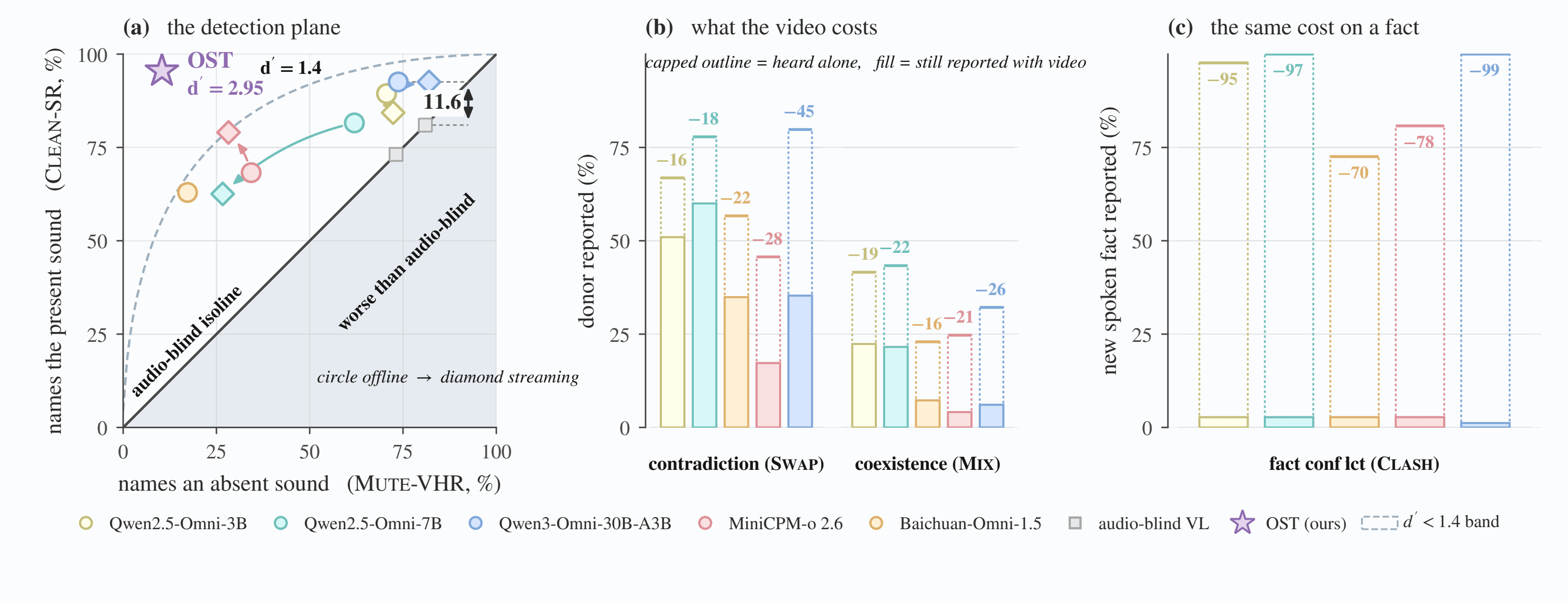
Naming the right sound on CLEAN cannot separate hearing from guessing, so we added two vision-only models that physically cannot read the audio track. They fix the zero point of the scale. Measured against it, every open omni-modal model we tested — across four families, three scales, and two generations — sits closer to that zero point than to OST.
d′ < 1.4Sensitivity of every open omni-modal model, offline or streaming
11.6 ptsWhat the entire audio pathway is worth when sound and image agree
0.77 → 0.44Audible evidence retained across the Qwen generation, while audibility itself does not move
2.95OST sensitivity · 2.1× the best baseline row
Sensitivity against the audio-blind zero point
d′ = z(CLEAN-SR) − z(MUTE-VHR), treating CLEAN as signal-present and MUTE as signal-absent. A model that cannot read the audio track scores exactly 0, because for it naming the true sound and hallucinating an absent one are the same event.
| Model | d′ ↑ | CLEAN-SR ↑ | MUTE-VHR ↓ | SWAP-AFR ↑ | MIX-JR ↑ | CLASH-Acc ↑ |
|---|
| Audio-blind reference · cannot read the audio track |
| Qwen2.5-VL-7B | 0.00 | 73.14% | 73.14% | 0.39% | 0.39% | 0.00% |
| Qwen3-VL-30B-A3B | 0.00 | 80.98% | 80.98% | 0.20% | 0.00% | 0.00% |
| Open omni-modal · offline |
| Qwen2.5-Omni-3B | 0.71 | 89.41% | 70.59% | 50.98% | 19.02% | 2.75% |
| Qwen2.5-Omni-7B | 0.59 | 81.57% | 61.96% | 60.00% | 19.41% | 2.75% |
| MiniCPM-o 2.6 | 0.88 | 68.24% | 34.31% | 17.25% | 0.78% | 2.75% |
| Baichuan-Omni-1.5 | 1.27 | 62.94% | 17.25% | 34.90% | 2.35% | 2.75% |
| Qwen3-Omni-30B-A3B | 0.81 | 92.55% | 73.73% | 35.29% | 4.51% | 1.18% |
| Open omni-modal · naive streaming thinking |
| Qwen2.5-Omni-7B | 0.94 | 62.55% | 26.67% | 28.43% | 1.76% | 0.59% |
| MiniCPM-o 2.6 | 1.38 | 79.02% | 28.24% | 25.10% | 3.33% | 4.90% |
| Qwen3-Omni-30B-A3B | 0.53 | 92.55% | 81.96% | 18.04% | 1.57% | 0.00% |
| OST (ours, streaming) | 2.95 | 95.49% | 10.39% | 81.76% | 51.37% | 46.47% |
The audio pathway buys agreement, not listening. Qwen3-Omni-30B-A3B reaches 92.55% on CLEAN against 80.98% for Qwen3-VL-30B-A3B, its audio-blind twin of the same generation and scale. Under agreement the entire audio pathway is therefore worth 11.6 points — small enough that a visual prior is a workable substitute for hearing, which is exactly what a CLEAN-only metric rewards.
The bottleneck is not the audio encoder
The same waveform is played twice: once through the native audio-only route with no video, and once with the locked video restored. The first is what the model can hear; the second is what it still reports. Their ratio is how much of its own hearing survives the image.
| Model (offline) | SWAP heard alone | with video | CMSG | retained | MIX heard alone | with video | CMSG | retained |
|---|
| Qwen2.5-Omni-3B | 66.86% | 50.98% | 15.88 | 0.76 | 41.57% | 22.35% | 19.22 | 0.54 |
| Qwen2.5-Omni-7B | 77.84% | 60.00% | 17.84 | 0.77 | 43.33% | 21.57% | 21.76 | 0.50 |
| MiniCPM-o 2.6 | 45.69% | 17.25% | 28.43 | 0.38 | 24.71% | 4.12% | 20.59 | 0.17 |
| Baichuan-Omni-1.5 | 56.67% | 34.90% | 21.76 | 0.62 | 22.94% | 7.25% | 15.69 | 0.32 |
| Qwen3-Omni-30B-A3B | 79.80% | 35.29% | 44.51 | 0.44 | 32.16% | 6.08% | 26.08 | 0.19 |
Audibility holds; entitlement collapsesFrom Qwen2.5-Omni-7B to Qwen3-Omni-30B-A3B the donor stays just as audible when only the waveform is played (77.84% → 79.80%), yet attribution with the video present falls by nearly half (60.00% → 35.29%) and suppression more than doubles (17.84 → 44.51). What changed is not the audio encoder but which channel is entitled to settle the question once the image is there.
Not a matter of scaleWithin one recipe, retention barely moves from Qwen2.5-Omni-3B to 7B (0.76 and 0.77). It only falls to 0.44 across the generation. The regression tracks the training recipe, not parameter count — which is why more scale alone will not fix it.
Not particular to one familyMiniCPM-o 2.6 fails differently: its audibility ceiling is already low (45.69%) and retention is low as well (0.38). Baichuan-Omni-1.5 keeps 0.62. Low retention appears in every family we could run, so it is a property of how omni models are trained rather than of one lab’s recipe.
Restraint alone does not repair itBaichuan-Omni-1.5 is by far the quietest model here (MUTE-VHR 17.25% against 61.96–73.73% for the Qwen offline rows) and by that route the most sensitive baseline (d′ = 1.27). It still discards 38% of what it demonstrably hears. Speaking less lowers hallucination without making the model listen.
Streaming pushes models toward the blind lineUnder naive streaming thinking, Qwen3-Omni-30B-A3B reports an absent sound 81.96% of the time, statistically indistinguishable from the 77.45% of its audio-blind twin, while its hit rate does not fall at all (CLEAN-SR is still 92.55%). What degrades under streaming is not hearing but staying silent when there is nothing to report.
The collapse is not “it says less”Qwen3-Omni-30B-A3B writes nearly twice as much as Qwen2.5-Omni-7B (61.9 vs 33.2 mean tokens) and reports more events on MUTE (1.376 vs 0.929 per answer), yet fewer on SWAP (1.239 vs 1.706). It is more talkative overall and specifically quieter about the donor, so verbosity cannot explain the drop.
Systems excluded from the headline, and why
These four runs completed but measure the protocol rather than auditory ability. We report them so the exclusions are auditable rather than silent.
Qwen3-Omni-30B-A3B-ThinkingUnder the locked 64-token budget every single answer is an unfinished scratchpad — </think> never appears, and output length is exactly 64 tokens on all 3,570 samples. MIX-JR = 0.00% is therefore not evidence that the donor was inaudible; the model never emitted an answer.
VITA-1.5Answers arrive as Chinese sound captions while JUDGE_V2.0.0 is an English lexical judge, so mentions almost never fire: mean events per condition ≈ 0.1 despite ~40 mean tokens. CLEAN-SR 5.69% is a language mismatch under the locked prompt and judge, not a measurement of hearing.
Qwen3-Omni-30B-A3B-CaptionerRun on native A-ONLY only, to test whether a captioning objective raises the audibility ceiling. It does not: SWAP donor recall is 18.04% against 79.80% for Instruct on the same waveforms. It spends its 64 tokens on ambient and music texture and under-names the donor.
Baichuan-Omni-1.5 · naive streamingIncomplete at 2,683 / 3,570. The 887 missing samples are all long locked-video clips that exhaust an H200 during a single packed prefill. Judging the remainder as N = 510 would bias CLEAN and MUTE, so only the offline row is reported.
Experimental results
OST follows auditory evidence across absence, contradiction, coexistence, and fact conflict
The event-level results use the same 510 matched Core groups with identical condition waveforms, PROMPT_V2, decoding contract, and unified judge. CLASH is a separate 510-item fact-conflict set with its own neutral cloze and deterministic fact matcher.
How to read: Higher is better for CLEAN-SR, SWAP-AFR, and MIX-DR/SR/JR; lower is better for MUTE-VHR and SWAP-VHR. The players above illustrate single-sample failure modes only; all percentages are aggregated over the complete 510-group Core.
51.37%
OST MIX joint recall
The same response reports both the true source and the added donor. The best baseline reaches 19.41%, an absolute improvement of 31.96 points.
2.95 d′auditory sensitivity, 2.1× the best baseline row
81.76%SWAP-AFR when donor audio contradicts the locked video
51.37%MIX-JR for reporting source and donor together
46.47%CLASH-Acc for following the new spoken fact
① Source recognition stays high
CLEAN-SR and MIX-SR (%, higher is better)
CLEAN-SRMIX-SR
Q2.5 · Naive streaming thinking
CLEAN
62.55
Q3 · Naive streaming thinking
CLEAN
92.55
② Visual hallucination under absence and conflict
MUTE-VHR and SWAP-VHR (%, lower is better)
MUTE-VHRSWAP-VHR
Q2.5 · Naive streaming thinking
MUTE
26.67
Q3 · Naive streaming thinking
MUTE
81.96
③ Following the actual donor
SWAP-AFR and MIX-DR (%, higher is better)
SWAP-AFRMIX-DR
Q2.5 · Naive streaming thinking
SWAP
28.43
Q3 · Naive streaming thinking
SWAP
18.04
④ Joint recognition under coexistence
MIX-JR: source and donor reported together (%, higher is better)
Q2.5 · Naive streaming thinking
1.76
Q3 · Naive streaming thinking
1.57
Interpretation: Baselines appear to recognize the visible source reliably on CLEAN/MIX-SR, yet commonly omit the concurrent donor. OST improves both donor recall and joint recall.
⑤ Following speech when visible text disagrees
CLASH-Acc (%, N=510). A-ONLY and A+V share the identical edited waveform; A+V additionally exposes the conflicting old fact in visible text.
| Method | A-ONLY ↑ | A+V / CLASH-Acc ↑ | Suppression gap ↓ |
|---|
| Qwen2.5-Omni-7B · naive streaming | 95.69% | 0.59% | 95.10 |
| MiniCPM-o 2.6 · naive streaming | 80.78% | 4.90% | 75.88 |
| Qwen3-Omni-30B-A3B · naive streaming | 94.12% | 0.00% | 94.12 |
| OST (ours, native streaming) | 100.00% | 46.47% | 53.53 |
CLASH reading. All three naive-streaming models recognize the edited speech in isolation but almost always revert to the visible old fact when video is restored. OST narrows this same-item suppression gap to 53.53 points, although the visible fact still wins often.
Lower hallucination is not achieved through silenceOST reaches 95.49% / 96.67% CLEAN-SR / MIX-SR while reducing MUTE/SWAP VHR to 10.39% / 4.71%.
Replacement and coexistence both improveOST reaches 81.76% SWAP-AFR, 54.31% MIX-DR, and 51.37% MIX-JR; the lower MIX values reflect genuine source competition.
Results are limited to hard casesChallenge is a reference-model-specific hard-case set. Point differences support stress diagnosis and should not be extrapolated to overall performance on natural data.
Audit trail
Unified evaluation contract and reproducible artifacts
Event-level Core rows use the same 510 groups, audio routing, PROMPT_V2, greedy decoding, and unified event judge. CLASH uses a separate frozen 510-item set, the same neutral cloze for every route, and a deterministic matcher for the mutually exclusive spoken and visible facts. Naive streaming thinking receives nominal 1 s chunks and answers only at the end; it is not native online generation.
Prompt“Describe all salient sounds you hear in this clip.”
JudgeJUDGE_V2.0.0 · assertion / negation / uncertainty aware
Statistical unitpaired source-cluster bootstrap; crossed source/donor clustering for reused donors
Predictionsoutputs/v2/inference/{qwen25,qwen25_omni3b,qwen3,qwen3_thinking,qwen3_captioner,qwen25_vl7b,qwen3_vl30b,minicpm_o26,baichuan_omni15,vita15}/{offline,chunked}/
Metricsseven event-level Core endpoints · d′ and CMSG · CLASH-Acc on a separate N=510 fact set
Human audit240 clips · 480 double-annotation assignments
Consistency contract. All seven event metrics use the same Core denominator. SWAP and MIX exactly match donor asset, segment, onset/offset, fades, gain, codec, and mastering. MIX is excluded from VHR, and A-ONLY retains audio identical to the linked AV condition. In CLASH, A+V and A-ONLY likewise share the identical edited waveform; only the conflicting visible old fact is added.
Final Challenge Core summary
All reported metrics in one table
The final event-level comparison retains seven complementary Core metrics, each computed from the same 510 matched source groups. Together they cover agreement, absence, contradiction, and coexistence. CLASH is reported separately above because it uses a distinct fact-level construction and judge.
| Method | CLEAN-SR ↑ | MUTE-VHR ↓ | SWAP-AFR ↑ | SWAP-VHR ↓ | MIX-DR ↑ | MIX-SR ↑ | MIX-JR ↑ |
|---|
| Audio-blind reference · every condition collapses onto the CLEAN value |
| Qwen2.5-VL-7B (Offline) | 73.14% | 73.14% | 0.39% | 73.14% | 0.39% | 73.14% | 0.39% |
| Qwen2.5-VL-7B (Naive streaming thinking) | 64.12% | 64.12% | 0.00% | 64.12% | 0.00% | 64.12% | 0.00% |
| Qwen3-VL-30B-A3B (Offline) | 80.98% | 80.98% | 0.20% | 80.98% | 0.20% | 80.98% | 0.00% |
| Qwen3-VL-30B-A3B (Naive streaming thinking) | 77.45% | 77.45% | 0.00% | 77.45% | 0.00% | 77.45% | 0.00% |
| Open omni-modal |
| Qwen2.5-Omni-3B (Offline) | 89.41% | 70.59% | 50.98% | 51.57% | 22.35% | 88.43% | 19.02% |
| Qwen2.5-Omni-3B (Naive streaming thinking) | 84.31% | 72.35% | 25.69% | 55.29% | 9.80% | 83.14% | 6.08% |
| Qwen2.5-Omni-7B (Offline) | 81.57% | 61.96% | 60.00% | 55.88% | 21.57% | 85.10% | 19.41% |
| Qwen2.5-Omni-7B (Naive streaming thinking) | 62.55% | 26.67% | 28.43% | 20.00% | 4.31% | 61.76% | 1.76% |
| MiniCPM-o 2.6 (Offline) | 68.24% | 34.31% | 17.25% | 35.88% | 4.12% | 66.27% | 0.78% |
| MiniCPM-o 2.6 (Naive streaming thinking) | 79.02% | 28.24% | 25.10% | 31.18% | 6.27% | 74.31% | 3.33% |
| Baichuan-Omni-1.5 (Offline) | 62.94% | 17.25% | 34.90% | 26.67% | 7.25% | 63.33% | 2.35% |
| Qwen3-Omni-30B-A3B (Offline) | 92.55% | 73.73% | 35.29% | 40.20% | 6.08% | 90.59% | 4.51% |
| Qwen3-Omni-30B-A3B (Naive streaming thinking) | 92.55% | 81.96% | 18.04% | 67.84% | 1.76% | 92.94% | 1.57% |
| OST (ours, streaming) | 95.49% | 10.39% | 81.76% | 4.71% | 54.31% | 96.67% | 51.37% |
OST exact counts (N=510): CLEAN-SR 487/510 · MUTE-VHR 53/510 · SWAP-AFR 417/510 · SWAP-VHR 24/510 · MIX-DR 277/510 · MIX-SR 493/510 · MIX-JR 262/510. CLASH-Acc is 237/510 on its separate fact-level set. CLASH A-ONLY is 510/510. SWAP-AFR and SWAP-VHR are not complements; MIX uses only DR/SR/JR and is excluded from VHR.