AAAI 2026 Oral

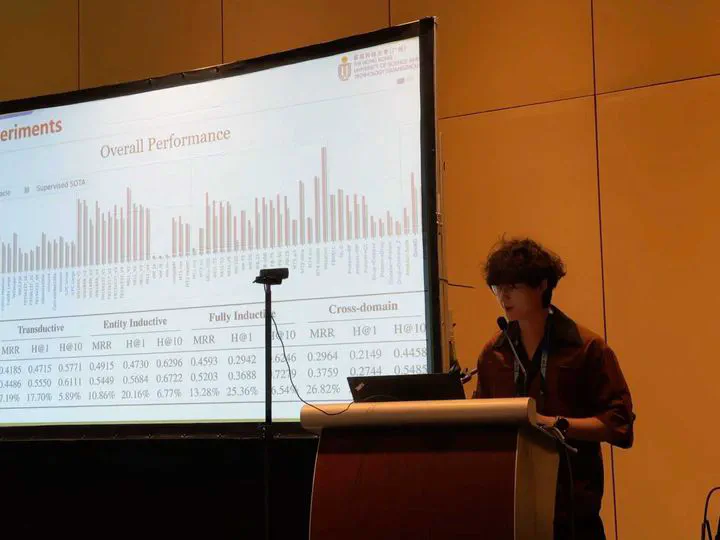 Oral Presentation at AAAI 2026
Singapore
Singapore EXPO, Singapore,
Click on the Slides button above to view the presentation materials, or watch the talk video for the full oral presentation.
🧠 GraphOracle: Efficient Fully-Inductive Knowledge Graph Reasoning
Our AAAI 2026 oral presentation introduces GraphOracle, a foundation model designed for universal and fully-inductive knowledge graph reasoning, with strong cross-domain generalization and biomedical applicability.
🚀 Key Contributions
Foundation Model for Knowledge Graph Reasoning
We propose GraphOracle, a novel foundation model that enables domain-independent and fully-inductive KG reasoning, addressing the limitations of static entity- and relation-dependent models.Relation-Dependency Graph (RDG)
GraphOracle models causal interaction structures among relations via Relation-Dependency Graphs, allowing reasoning to generalize to unseen entities, relations, and domains.Cross-Domain & Biomedical Reasoning
By integrating multiple unimodal foundation models, GraphOracle demonstrates strong cross-domain transferability, extending naturally to biomedical knowledge graphs (BioKGs).Efficient Adaptation with Minimal Fine-Tuning
Extensive experiments on Transductive, Inductive, and BioKG benchmarks show that GraphOracle consistently outperforms existing methods and can surpass state-of-the-art models with very limited fine-tuning.
📊 Experimental Results
GraphOracle achieves:
- Superior reasoning accuracy across multiple KG benchmarks
- Robust performance under inductive and cross-domain settings
- Strong scalability and efficiency suitable for large, evolving knowledge graphs
🔗 Resources
- 📄 Paper: arXiv:2505.11125
- 💻 Code: https://github.com/EnjunDu/GraphOracle
- 📑 Slides: AAAI 2026 Presentation Slides
- 🎥 Talk Video: YouTube
For more information about the conference, please visit the AAAI 2026 website.