Neural Knowledge Graph Reasoning with Relational Digraph

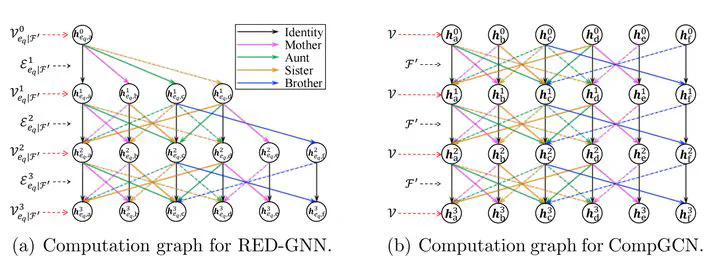 Image credit: Unsplash
Abstract
Reasoning on Knowledge Graphs (KGs) aims to deduce unobserved facts from established ones. While path-based methods are interpretable and transferable, they struggle to capture complex graph topologies. Conversely, subgraph-based approaches preserve structure but often face high computational overhead. To unify these strengths, we introduce the relational directed graph (r-digraph), a structure that generalizes relational paths into layered subgraphs to capture rich local evidence. To overcome the computational burden of processing individual subgraphs, we propose RED-GNN. By observing that r-digraphs for a common query share overlapping paths, RED-GNN utilizes dynamic programming to recursively encode multiple r-digraphs with shared edges. Furthermore, to address the dynamic nature of real-world facts, we extend this framework to T-RED-GNN for temporal knowledge graphs (tKGs). T-RED-GNN introduces a relative temporal encoding mechanism that enables a unified approach to both interpolation and extrapolation tasks. Extensive experiments show that our methodologies significantly outperform state-of-the-art static and temporal reasoning models. Moreover, the learned attention weights provide transparent, interpretable evidence for the reasoning process. The code is available at https://github.com/LARS-research/RED-GNN.
Type
Publication
In Artificial Intelligence
Click the Cite button above to demo the feature to enable visitors to import publication metadata into their reference management software.