TEMPORAL RESPONSIBILITY
Work persistence
From responsibility that closes at delivery to responsibility that remains open across stages, feedback, and later events.
Closes at deliveryStanding obligation
A SURVEY OF DIGITAL KNOWLEDGE WORK 2026
Systems, Capabilities, and Optimization
From generating responses to carrying out digital work.

Interpret evidence · Produce answers
Edit a local object · Verify the change
Dependent actions · Complete an objective
Coordinate stages and handoffs
Connect related objects · Track dependencies
Expanding work scope and dependencies.Explore the survey
The unit of progress is an outcome that meets its requirements and can be used downstream.
Read the introductionAs foundation models evolve from information generation to digital work execution, agents are increasingly capable of completing complex tasks across tools, applications, and workflows. However, existing research lacks a unified perspective on how agents reliably accomplish delegated work. To address this gap, we present a work-centric, system-level perspective that views work agents as systems combining foundation models and runtime harnesses to execute tasks in stateful workspaces and deliver verifiable outcomes. We introduce two complementary dimensions, work persistence and work openness, to characterize working conditions, and classify digital work into five forms according to task scope and organization. Building on this framework, we identify five core capability families required for reliable work execution and examine approaches to model optimization, harness optimization, and their joint optimization. We further analyze existing evaluation methods and metrics from the perspective of work outcomes. Finally, we discuss future research directions, including sustained work delegation, adaptation to open environments, and the interaction between work execution and capability improvement. This paper provides a unified framework for understanding, optimizing, and evaluating work agents, supporting the development of systems capable of delivering reliable, verifiable, and practically valuable work outcomes.
From the manuscript · Systems, capabilities, optimization, and evaluation
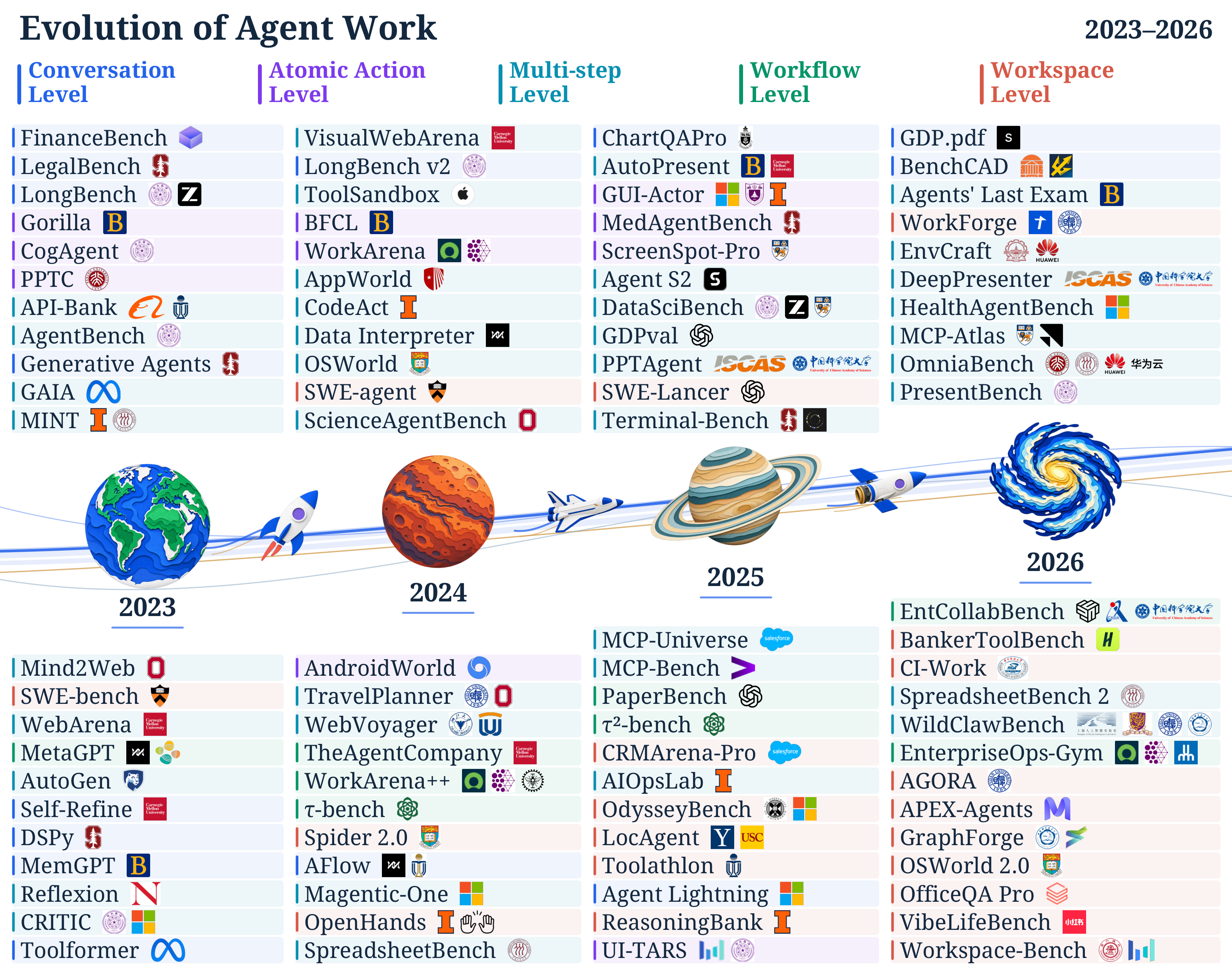
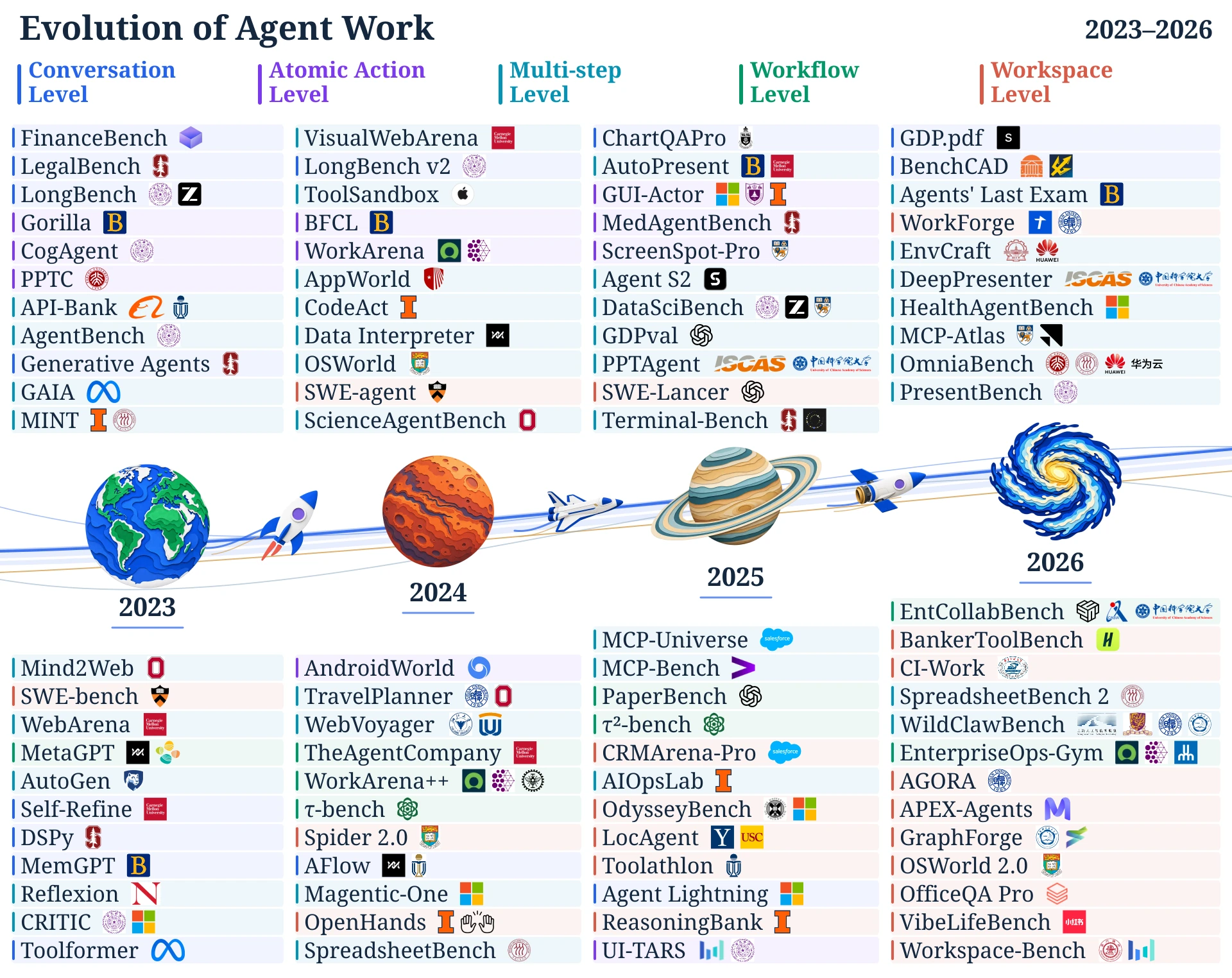
Figure 4 · Evolution of agent work through 90 representative works in 2023–2026. Colors classify selected task settings.
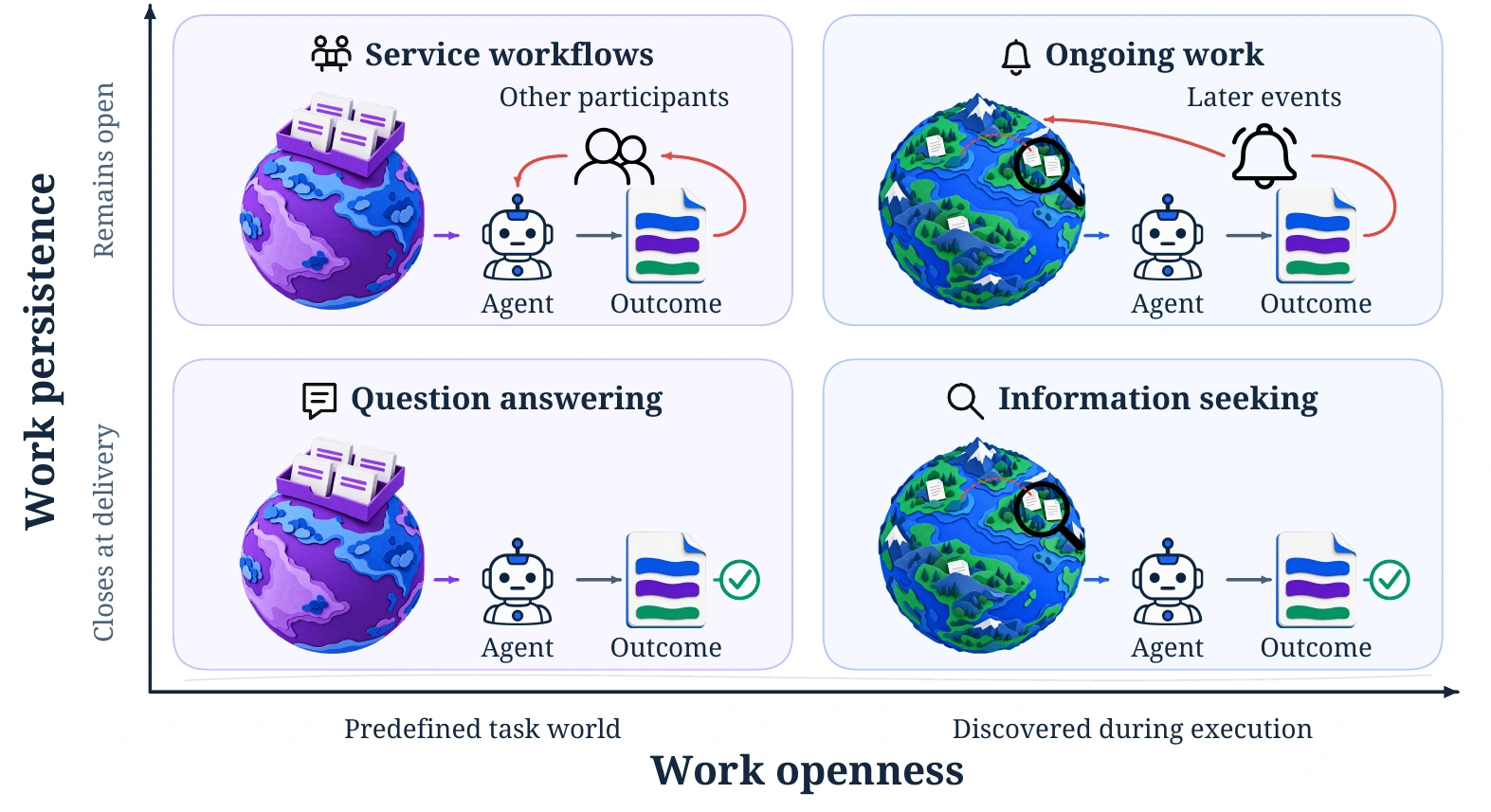
Explore the figurePersistence asks when delegated responsibility can close. Openness asks what must be discovered during execution. They describe working conditions alongside the scope and structure of work.
From responsibility that closes at delivery to responsibility that remains open across stages, feedback, and later events.
From enumerated materials and interfaces to a workspace whose objects, relations, authority, and actors must be discovered while working.
These axes describe working conditions. They are independent of intelligence and autonomy.
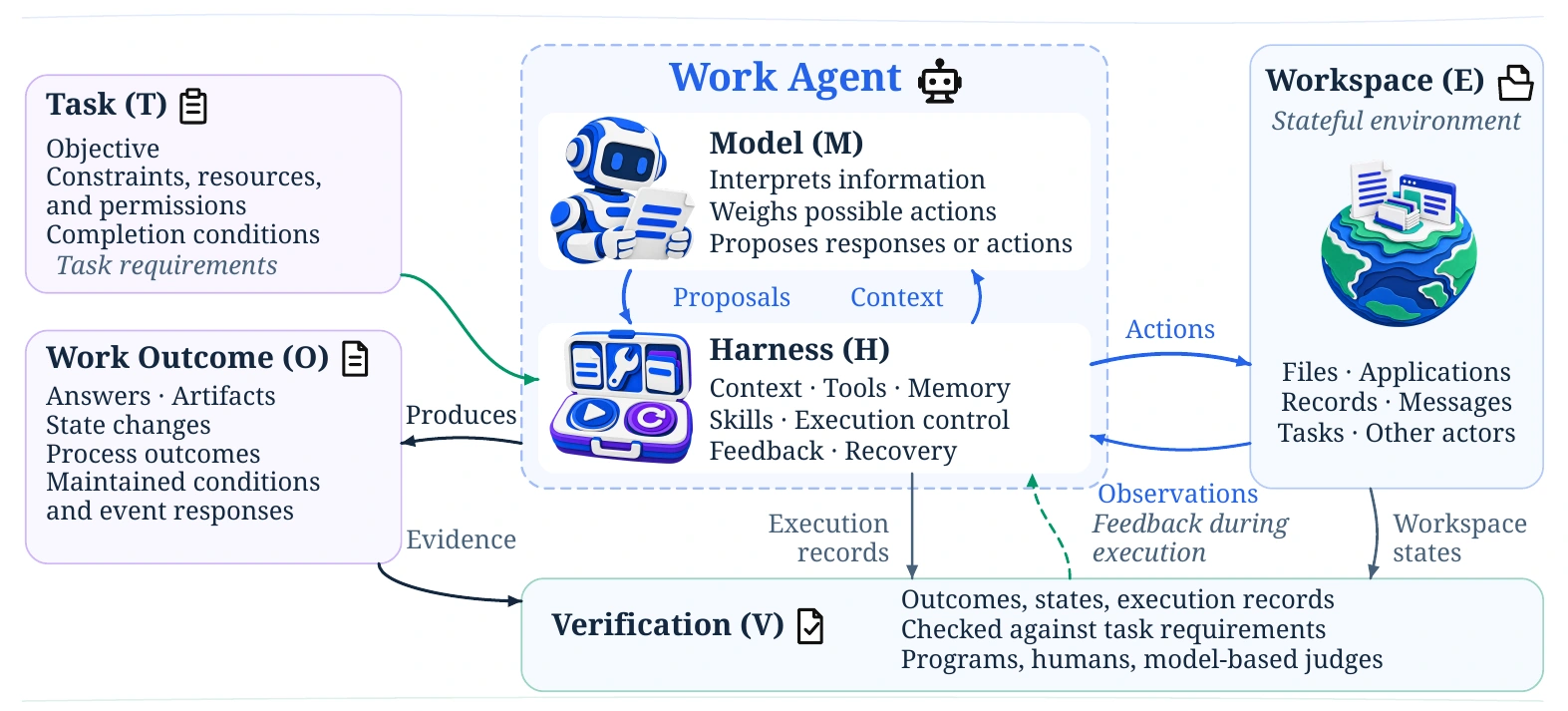
A foundation model supplies reasoning and decisions. A harness organizes context, tools, memory, and control. They act in a stateful workspace under task requirements.
Task & initial state → trajectory, resulting state & outcome → assessment
Five forms describe the scope and organization of delegated work. Scope concerns objectives, stages, objects, and dependencies.
Interpret a request and its associated evidence to produce an answer, analysis, classification, judgment, or specification. Completion is assessed on the returned information, without requiring a change to source artifacts or external state.
Read in the surveyAnalyze a financial report and answer a numerical question.
Apply a local operation to a clearly defined work object and confirm its intended effect. The scope of the objective defines this form; several mouse, keyboard, or API operations may still be needed.
Read in the surveyCorrect a formula in cell C7 and confirm the intended result.
Coordinate dependent actions toward a complete objective. Intermediate results supply evidence or state for later decisions, and execution feedback can change the remaining sequence. Completion is assessed on the final result.
Read in the surveyPrepare data, run analysis code, and deliver an executable analysis.
Advance a delegated operational process through stages, procedural requirements, approvals, and interactions with other participants. Completion covers the process outcome as well as the final output.
Read in the surveyCollect reporting data, prepare artifacts, obtain approval, and publish.
Establish which files, records, and applications bear on the goal and how they are related. Locate relevant objects, reconcile evidence and versions, and preserve consistency among affected objects when updates are required.
Read in the surveyTrace a report to its source workbook and update dependent presentations.
Work forms describe scope and organization. Persistence and openness describe the conditions in which that work is carried out. A longer sequence of actions can still close at delivery.
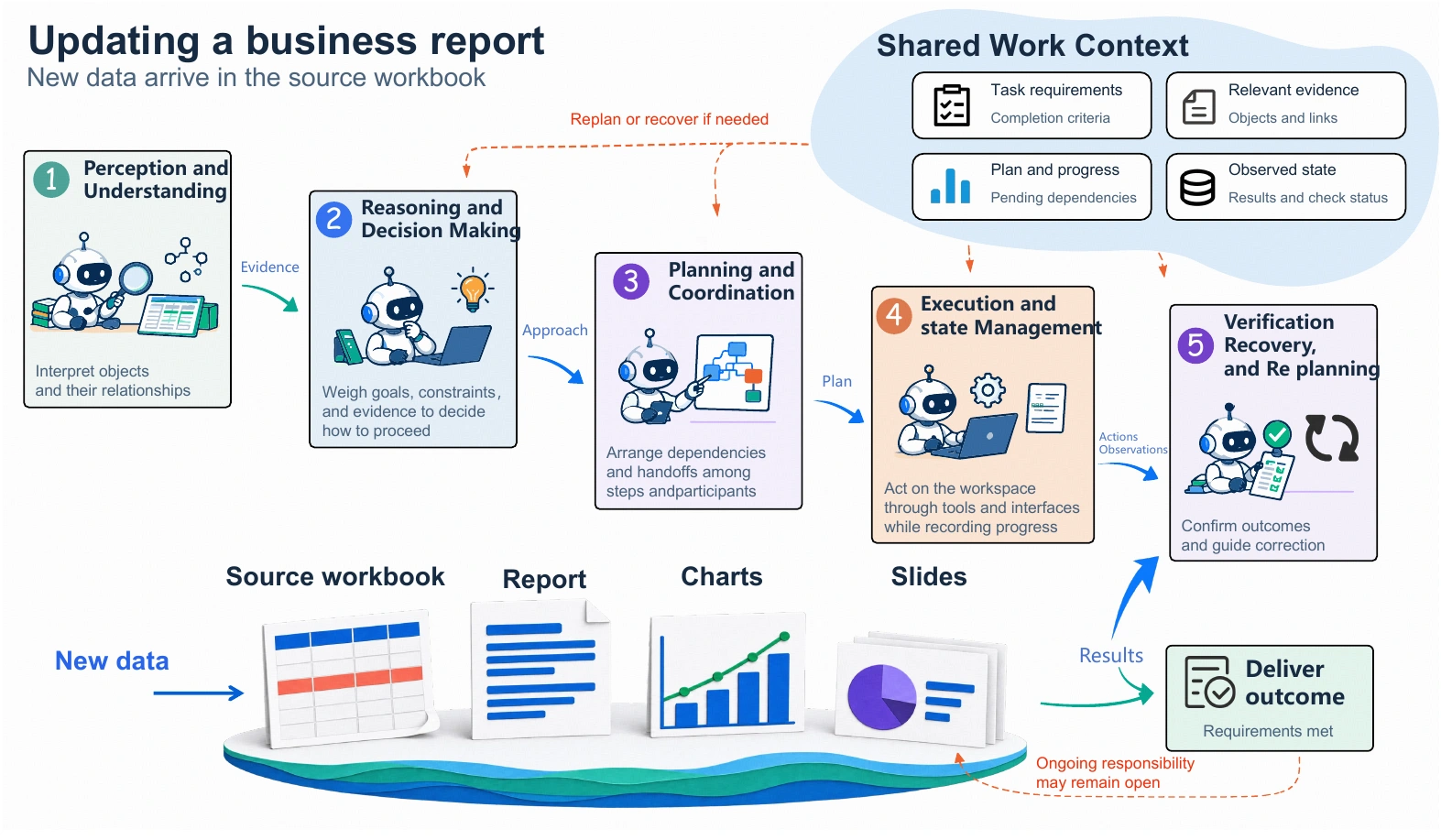
Five capability families form a recurring cycle around shared work context. Evidence guides decisions; verification can send work back to the capability where a problem arises. The running example updates a workbook, report, charts, and slides.
Read native work objects, identify relevant evidence, and trace sources, versions, and dependencies across the workspace.
Reconcile evidence with goals, professional knowledge, business rules, and constraints before choosing an action.
Decompose objectives, track prerequisites, coordinate stages and participants, and manage branches and handoffs.
Act on the workspace, distinguish attempted actions from committed changes, and preserve consistency across objects and applications.
Check outcomes against requirements, investigate uncertain effects, and recover or replan when assumptions fail.
The capabilities form a cycle. An accepted delivery may close a bounded task while an ongoing responsibility remains active.
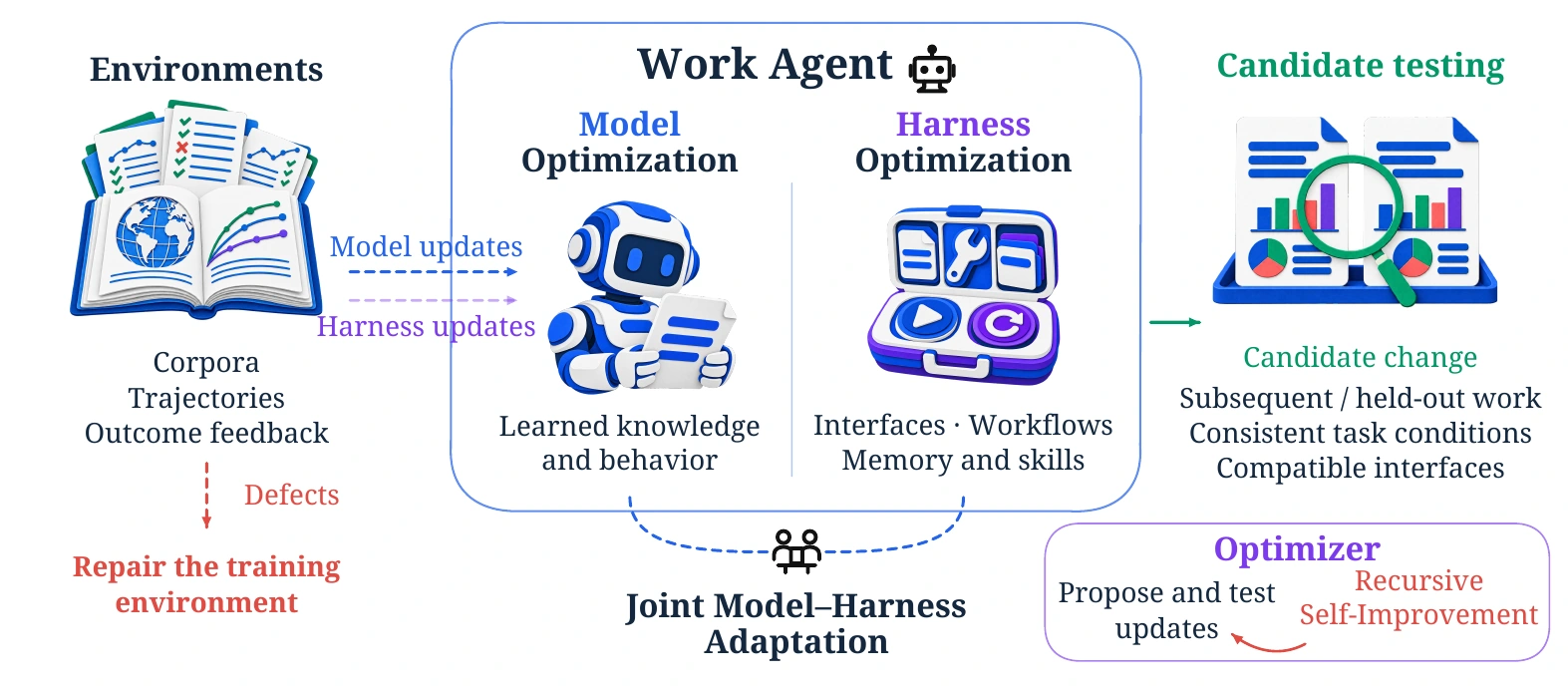
Diagnose the failure before choosing what to update. The right intervention can reside in model parameters, external support, or their coupling.
Work materials, services, dependencies, and situations in which actions have observable effects.
Domain corpora, demonstrations, interaction trajectories, and examples of recovery.
State checks, outcome verification, rubrics, and rewards that connect behavior to requirements.
Internalize reusable interpretation and decision patterns in model parameters.
Repair what the model can observe, invoke, remember, and verify during execution.
Account for the interaction between learned behavior and the harness supporting it.
Compare (M₀, H₀), (M₁, H₀), (M₀, H₁), and (M₁, H₁) on matched tasks, states, verifiers, and budgets to separate model gains, harness gains, and their interaction.
Connect the work requested to the evidence inspected, the judging method, and the reported metric. Assess quality and reliability alongside cost and value in use.
Does the response satisfy the question and agree with its supporting evidence?
Reference answers · Source supportDid the intended effect actually happen, with relevant constraints and other state preserved?
Tests · Database checks · EffectsIs the native deliverable correct, editable, source-consistent, and usable in its intended form?
Native objects · Rendered viewsWere dependencies, prerequisites, approvals, and intermediate obligations respected?
Checkpoints · Traces · HandoffsA task can request a correct, editable, source-consistent workbook while a verifier checks selected cells. Those checks establish correctness over the inspected cells; editability, provenance, and other structure need corresponding evidence.
Accepted work meets the brief. Value in use concerns what the result helps people achieve. Total effort includes human supervision, correction, and computational cost.
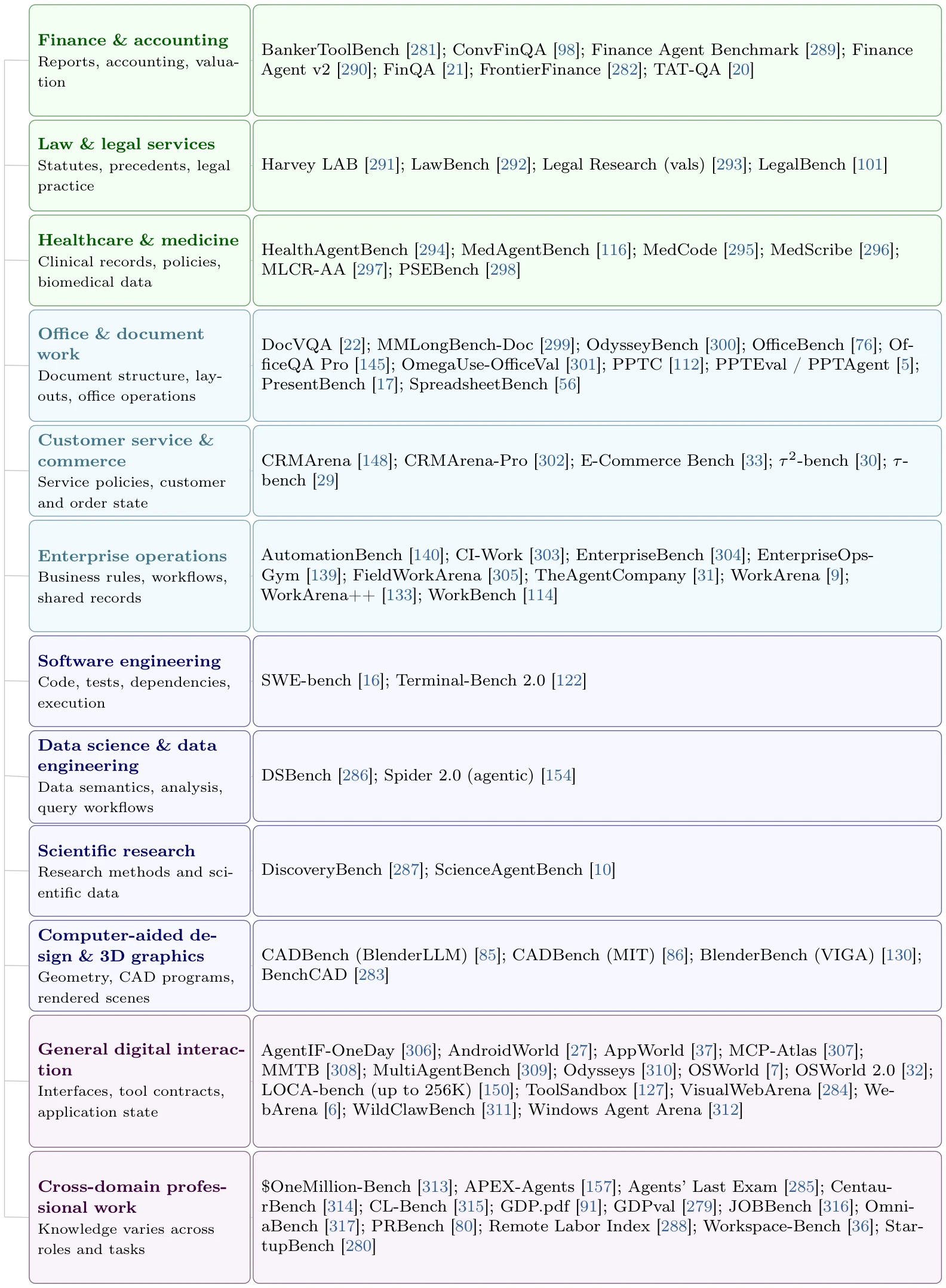
Performance, cost & value ↗30 representative benchmarks and systems drawn from the survey. Browse by work form, then compare the work domain and evidence each resource inspects.
| Resource / year | Work form | Domain | Assessment evidence | Paper link |
|---|---|---|---|---|
| Workspace-Bench2026 · Ref. 36 | Workspace | Professional | Rubrics + file-dependency graph | ↗ |
| OfficeBench2024 · Ref. 76 | Workflow | Office | Office environment task completion | ↗ |
| SWE-bench2023 · Ref. 16 | Workspace | Software | Required fixes + regression tests | ↗ |
| OSWorld2024 · Ref. 7 | Multi-step | Computer use | Task-specific execution checks | ↗ |
| AppWorld2024 · Ref. 37 | Multi-step | Enterprise | Goal state + collateral-state checks | ↗ |
| GDPval2025 · Ref. 279 | Multi-step | Professional | Blinded occupational-expert comparison | ↗ |
| PresentBench2026 · Ref. 17 | Multi-step | Office | Model-judged binary checklist on rendered decks | ↗ |
| τ-bench2024 · Ref. 29 | Workflow | Enterprise | Database goal-state comparison | ↗ |
| τ²-bench2025 · Ref. 30 | Workflow | Enterprise | Shared-state and policy evaluation | ↗ |
| TheAgentCompany2024 · Ref. 31 | Workflow | Enterprise | Intermediate checkpoints + final completion | ↗ |
| WorkArena++2024 · Ref. 133 | Workflow | Enterprise | Enterprise application outcomes | ↗ |
| CRMArena2024 · Ref. 148 | Workspace | Enterprise | Answers to CRM queries | ↗ |
| CRMArena-Pro2025 · Ref. 302 | Workspace | Enterprise | Answer correctness + confidentiality awareness | ↗ |
| SpreadsheetBench 22026 · Ref. 121 | Multi-step | Office | End-to-end spreadsheet workflow assessment | ↗ |
| EnterpriseOps-Gym2026 · Ref. 139 | Workflow | Enterprise | SQL outcome + integrity checks | ↗ |
| StartupBench2026 · Ref. 280 | Workspace | Professional | Weighted, tool-assisted rubric judgments | ↗ |
| DABstep2025 · Ref. 126 | Multi-step | Professional | Multi-step data analysis outcomes | ↗ |
| DSBench2024 · Ref. 286 | Multi-step | Professional | Data-analysis and modeling results | ↗ |
| ScienceAgentBench2024 · Ref. 10 | Multi-step | Science | Data-driven scientific task assessment | ↗ |
| PaperBench2025 · Ref. 136 | Workflow | Science | Hierarchical research-replication rubric | ↗ |
| WebArena2023 · Ref. 6 | Multi-step | Computer use | Answer or required website state | ↗ |
| SpreadsheetBench2024 · Ref. 56 | Multi-step | Office | Target cells across workbook test cases | ↗ |
| ToolSandbox2024 · Ref. 127 | Multi-step | Enterprise | State milestones + specified minefields | ↗ |
| SheetCopilot2023 · Ref. 4 | Multi-step | Office | Spreadsheet operations and task outcomes | ↗ |
| InstructExcel2023 · Ref. 111 | Atomic Action | Office | Concrete Excel instruction execution | ↗ |
| API-Bank2023 · Ref. 25 | Multi-step | Tool use | API selection, arguments, and execution | ↗ |
| ScreenSpot-Pro2025 · Ref. 115 | Atomic Action | Computer use | Localized interface target grounding | ↗ |
| DocVQA2020 · Ref. 22 | Conversation | Professional | ANLS against reference answers | ↗ |
| FinQA2021 · Ref. 21 | Conversation | Professional | Numerical result + program equivalence | ↗ |
| LegalBench2023 · Ref. 101 | Conversation | Professional | Expert-designed labels or references | ↗ |
Try another keyword, work form, or domain.
Representative placements are a reading aid; work forms can overlap. Reference numbers follow the current manuscript; years identify the selected releases. Evidence descriptions summarize the stated configurations.
Personal work agents, human digital twins, and organizational work systems make sustained delegation concrete. They motivate advances in environment, persistence, and verification.
Carry a user’s goals across requests; advance unfinished work and choose when their attention is needed.
Represent a particular person’s judgment, with separate checks for professional quality and personal fidelity.
Connect contributions, decision rights, and dependencies across people and agents.
Construct work environments that preserve realistic objects, relationships, histories, and professional requirements. Study transfer across work settings and differences between people.
Held-out transfer · Source selection · Realistic curriculaRetain goals, judgments, commitments, and dependencies across events and interruptions. Choose when to observe, ask, act, or wait, and adapt procedures without losing track of current work.
Fulfilled obligations · Duplicate effects · ContinuityAssess deliverable quality, a digital twin’s agreement with the represented person, and the return on delegation separately. Follow benefits and human and computational effort through delivery and downstream use.
Work quality · Personal fidelity · Return on delegation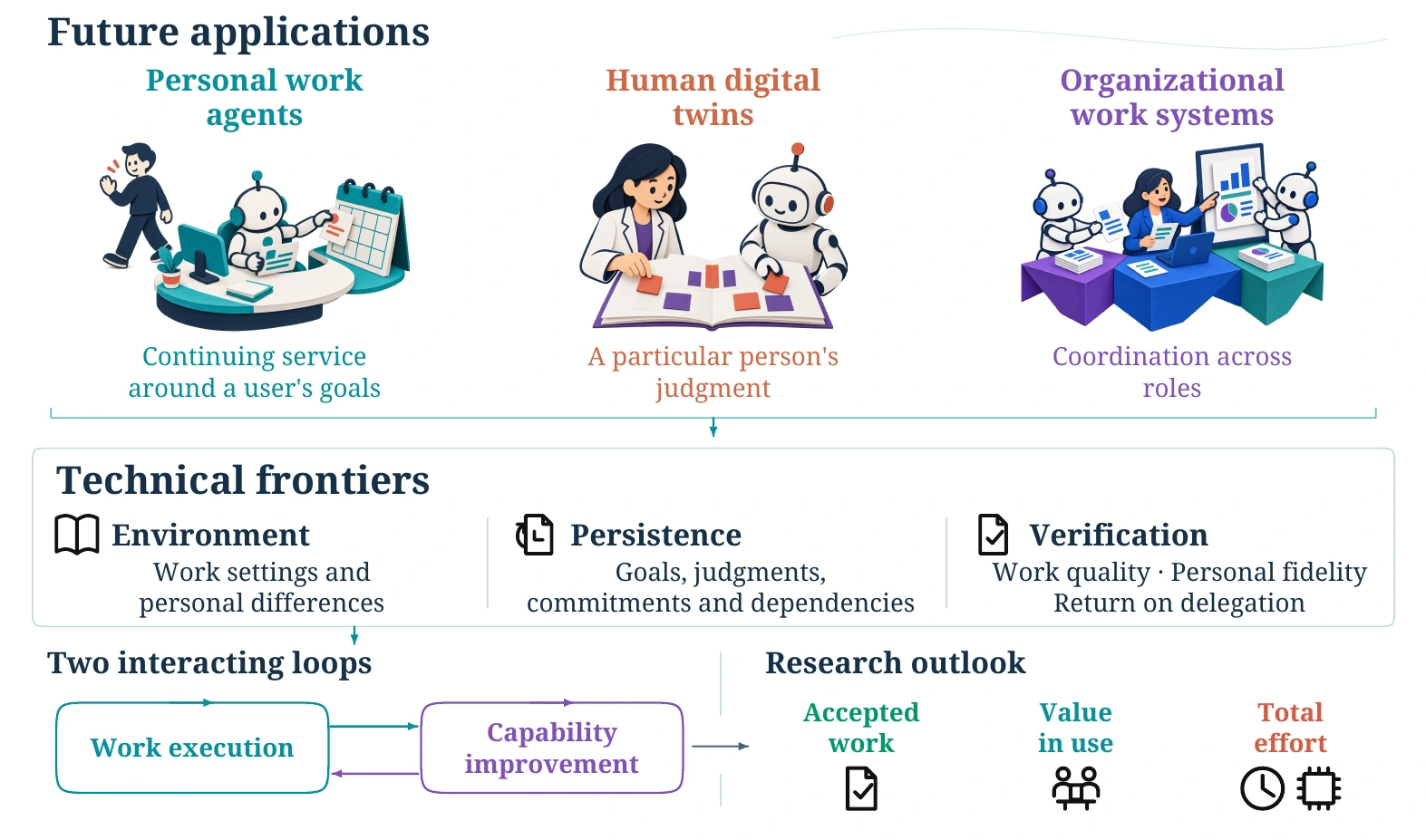
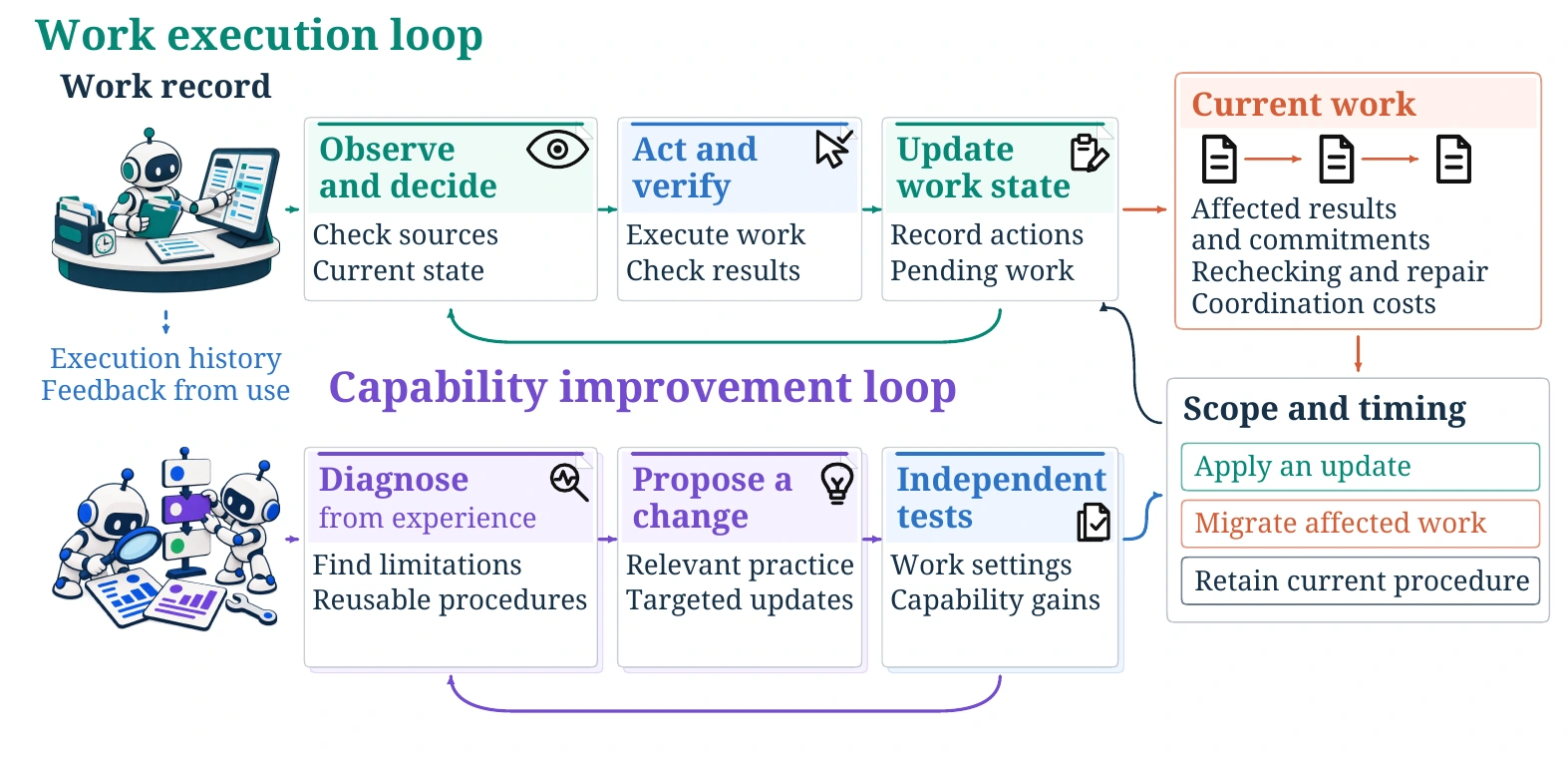
Trace an update’s effects while current responsibilities continue.
Observe & decide → Act & verify → Update work state
Retain agreed requirements, source versions, and pending work.Diagnose → Propose a scoped update → Test independently
Use execution history and feedback from downstream use.Before applying an update: trace affected results and commitments. Weigh capability gains against rechecking, repair, and coordination costs, then apply the update, migrate affected work, or retain the current procedure.
Work delivered.
Outcomes accepted.
The full survey connects the foundations, capabilities, optimization methods, evaluation resources, and open challenges of work agents.
Read the full survey@misc{workagents2026,
author = {Zishan Xu and Enjun Du and Mingqi Gao and
Cheng Yang and Junhao Shen and Zirong Chen and
Zhiyuan Yao and Yifu Guo and Yuquan Lu and
Jinyang Huang and Zhengxi Lu and Siyi Liu and
Ziyu Zheng and Yongqi Zhang and Difan Zou and
Weiwen Liu},
title = {Work Agents: Systems, Capabilities,
and Optimization},
year = {2026},
eprint = {2610.35845},
archivePrefix = {arXiv},
primaryClass = {cs.LG},
url = {https://arxiv.org/abs/2610.35845}
}